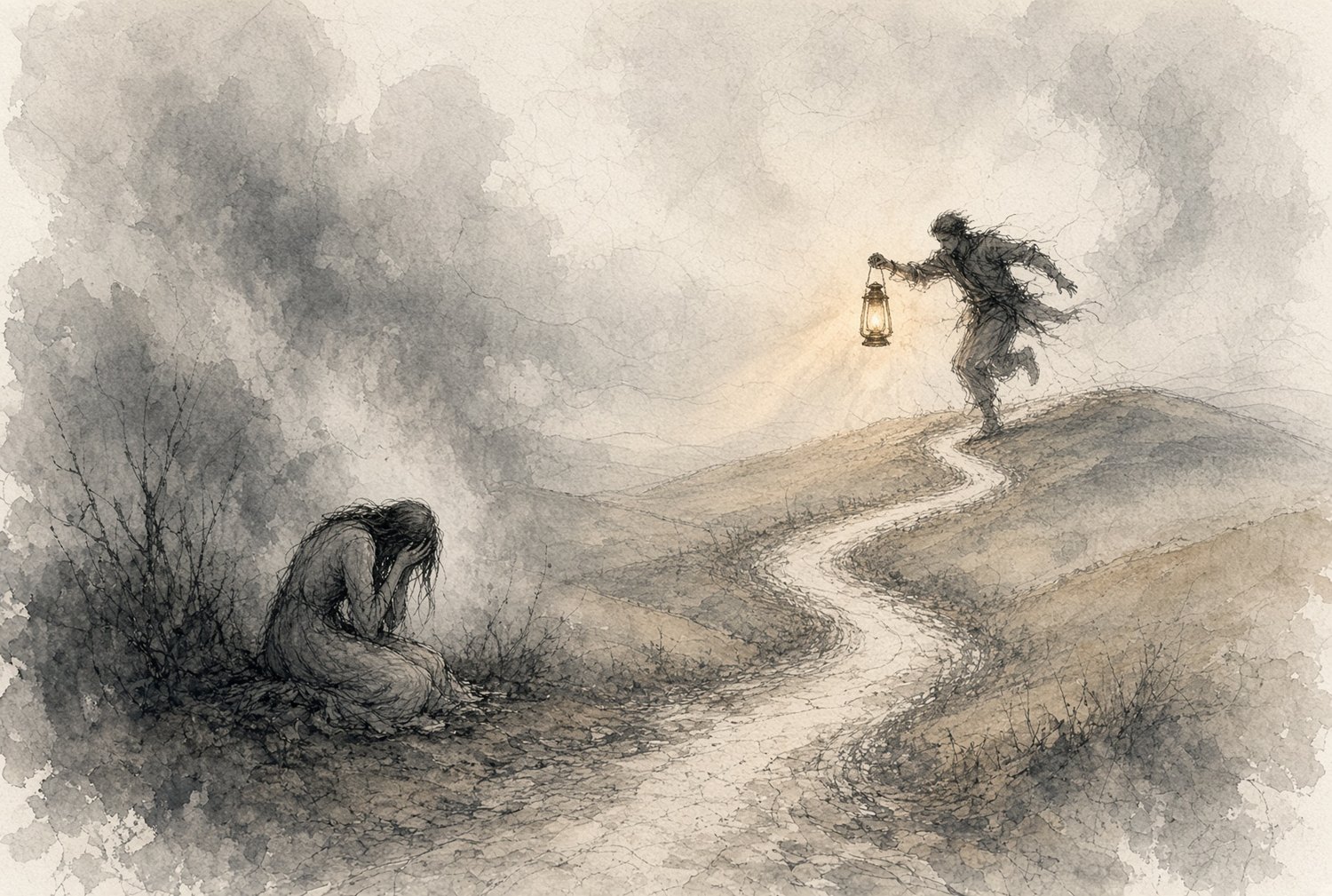
"Hurt" is one song with two lives. Trent Reznor wrote it in his late twenties, near the bottom of his own despair. Johnny Cash sang it at 70, months from his grave. The words barely changed. The meaning changed completely.
In Reznor's hands, the song is a young man's cry from inside the pit. In Cash's, it becomes an old man's confession over the whole of his life. Between the two stands a book of the Bible written for exactly this moment. Ecclesiastes is the testimony of a king who had everything, looked back on it, and called it vapor. It ends in a command to remember.
Reznor's Song
"Hurt" closes The Downward Spiral, the 1994 Nine Inch Nails album. Reznor has described the album's arc as a man trying to find salvation through sex, drugs, self-destruction and self-loathing. Thirteen songs of noise and rage lead down. "Hurt" is where the descent stops.
The song is quiet after all that violence. Its narrator has hurt himself to find out whether he can still feel anything. He has numbed himself until pain is the only thing left that seems real. He knows he has let down everyone close to him. He offers them everything he has, and he calls all of it worthless.
Yet Reznor meant the song as a sliver of light. Far Out notes that he saw it as a small piece of hope at the album's end, and that it worked only because of what came before it. Looking back on it in Netflix's Song Exploder, he recalled feeling "alone. Lost." The hope is faint. In the final verse, the narrator imagines a second chance and a different self. That is all he has. But he still has it.
Cash's Song
Producer Rick Rubin brought the song to Cash for American IV: The Man Comes Around (2002). It was the last album Cash released in his lifetime. He could no longer tour. His voice was cracked and thin. Rubin, by Songfacts' account, saw the lyrics as a song about regret.
That one shift in the singer changes everything. When a young man sings of failing the people he loves, it is a confession in progress. When a dying man sings it, it is a verdict. The fame and the gold records are behind him. He is weighing them now, and they are light.
Director Mark Romanek shot the video in February 2003 at the House of Cash in Hendersonville, Tennessee. It was a shuttered museum to Cash's own career, flood-damaged and decaying. Romanek cut footage of the young, swaggering Cash against the old man at the piano. Near the end, June Carter Cash stands on a staircase and watches her husband. She died on May 15, 2003. Johnny followed on September 12.
Reznor had been wary of the cover. He thought it sounded like a gimmick. Then he watched the video. He described tears and goosebumps, and said the song was no longer his.
The Preacher's Reckoning
Ecclesiastes is written in the voice of the Preacher, a king in Jerusalem who had more than any man before him. He built houses and planted vineyards. He gathered silver and gold. He kept singers. Then he looked back over all of it. "Behold, all was vanity and vexation of spirit, and there was no profit under the sun" (Ecclesiastes 2:11).
The Hebrew word is hevel. It means vapor or breath. It is the fog of your breath on a cold morning, there and then gone. That is what the Preacher calls his empire. It is also what Cash calls his, standing in the ruins of his own museum.
The Preacher saw no profit in what he built, and he knew he could not take it with him. Cash's narrator says the same: the people he failed may have all of it. He offers his kingdom away because, at the end, it was only ever dust. Romanek's camera makes the point without a word. It lingers on a smashed gold-record frame and a feast left to rot on the table.
Ecclesiastes does not stop at vanity. Its last chapter turns. It describes old age in images of failing strength, until "the dust return to the earth as it was: and the spirit shall return unto God who gave it" (12:7). Then it gives the conclusion of the whole matter: "Fear God, and keep his commandments" (12:13). The vanity is real. But it is not the last word.
The Crown of Thorns
Cash changed only one line of Reznor's lyric. In the original, the narrator wears a crown of filth on a liar's throne. Cash made it a crown of thorns. It may have started as a way to drop the profanity. It did far more than that.
Reznor's crown is self-contempt. It is the crown a man gives himself when he has judged his own life and found it rotten. Cash's crown belongs to someone else. The soldiers pressed it onto Messiah's head in mockery before the cross (Matthew 27:29). With one word, Cash takes his guilt and sets it beside the One who bore it.
To the Roman soldiers, the crown was a joke. They dressed a beaten Jew in purple and hailed him as a king. Pilate brought him out and said, "Behold the man!" (John 19:5). They meant to humiliate him. They could not know they were telling the truth.
They could not know what thorns meant either. In Scripture, thorns first appear at the fall. God says to Adam, "cursed is the ground for thy sake; in sorrow shalt thou eat of it all the days of thy life; Thorns also and thistles shall it bring forth to thee" (Genesis 3:17–18). Thorns are the curse made visible. They are what the ground grows when man is cut off from God.
So the soldiers placed the emblem of the curse on Messiah's head. Paul names what happened there: "Christ hath redeemed us from the curse of the law, being made a curse for us" (Galatians 3:13). The last Adam wore the first Adam's thorns. Many readers have seen this foreshadowed in Abraham's ram, the substitute caught by its horns in a thicket on Mount Moriah (Genesis 22:13).
The prophets promised the curse would not last. Isaiah 55 is God's invitation to the thirsty and the wicked to return and be pardoned. It ends with creation itself singing, and the trees of the field clapping their hands. Then comes the last verse: "Instead of the thorn shall come up the fir tree, and instead of the brier shall come up the myrtle tree" (Isaiah 55:13).
Both trees are chosen with care. The KJV's fir is the Hebrew berosh, which many modern translations render cypress. Solomon used it in the temple for the floor and the doors. David's musicians played on instruments of fir wood before the ark. The thorn becomes the stuff of worship.
The myrtle is lowlier, and lovelier. In Hebrew it is hadas. Esther's Hebrew name was Hadassah, the orphan raised from obscurity to become the bride of the king. In Zechariah's vision, the angel of the LORD stands among myrtle trees in a hollow, a picture many interpreters read as Israel in her humble state. The thorn becomes the bride.
This is what Cash's one-word change carries. Reznor's crown is the curse with no remedy. Cash's crown is the curse borne by another, and turned at last into cypress and myrtle.
The narrator still sits on a liar's chair. Cash does not excuse himself. He had spent decades fighting addiction, and he knew his failures better than his critics did. But the crown of thorns changes what the confession means. Shame alone ends in the pit where Reznor's narrator sits. Shame brought to the cross can end in grace.
The album makes the same claim. On American IV, "Hurt" follows the title track, which Cash wrote from the Book of Revelation. The record sets the end of all things right before the end of one man's life. Cash knew whose judgment he was facing.
Remember Thy Creator
The Preacher's final chapter opens with a warning to the young. "Remember now thy Creator in the days of thy youth, while the evil days come not" (Ecclesiastes 12:1). The two versions of "Hurt" read like two halves of that verse.
Reznor's narrator is the young man in the pit. He has not yet remembered. His hope is a guess that he might somehow find himself again. Cash's narrator is the old man in the evil days. His strength is failing and the grinders are few. He remembers. And because he remembers, his confession is itself an act of hope.
Both versions end on the same wish. The singer longs for a second start and a self that does not get lost this time. From a young man, it is a fragile hope. From Cash, it is a prayer for the life to come. He could not go back and live his years again. He could bring them to the One who wore the crown of thorns.
That is why the song now belongs to Cash, as Reznor himself said. The words describe a ruin. The man singing them had found where a ruined life can go.